
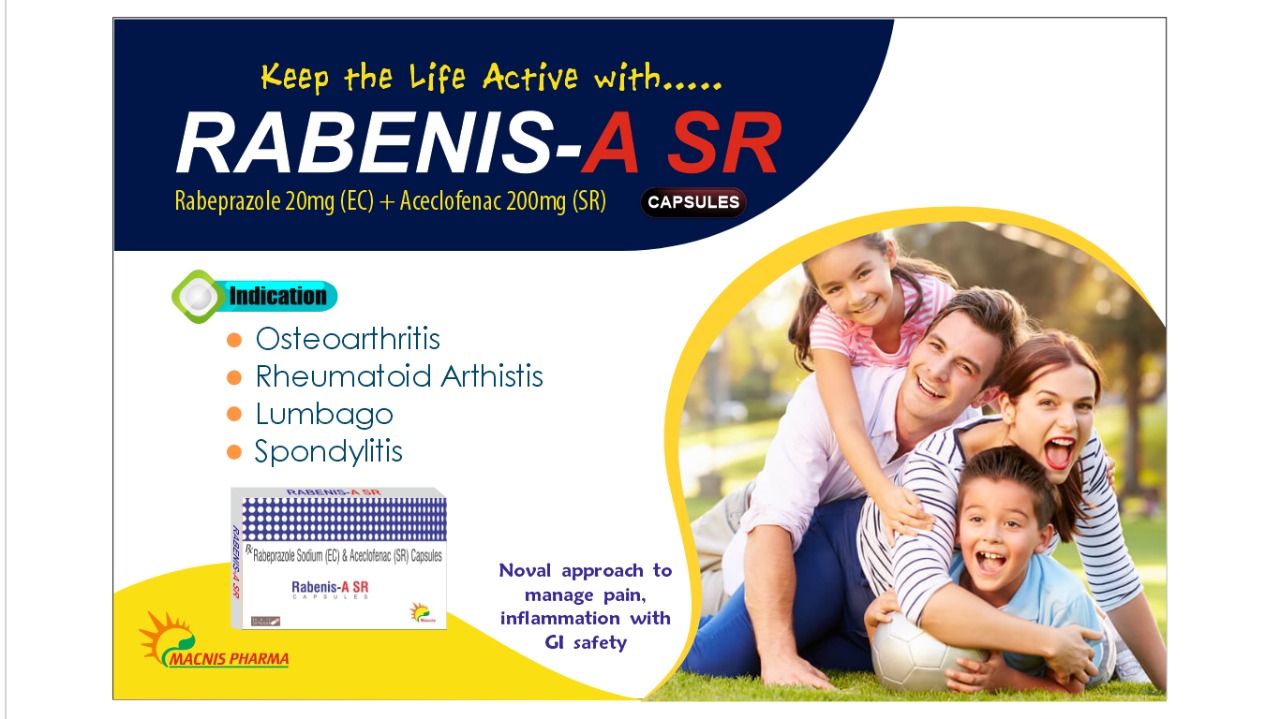
RABENIS
ASR
For the use
only of a Registered Medical Practitioner or Hospital or a Laboratory
Abbreviated Prescribing information
for RABENIS 20
(Rabeprazole sodium 20 mg & Aceclofenac 200 mg Capsules I.P.)
[Please refer the complete
prescribing information available at www.macnispharma.com ]
PHARMACOLOGICAL
PROPERTIES: Rabeprazole belongs to a class of antisecretory compounds
(substituted benzimidazole proton-pump inhibitors) which suppress gastric acid
secretion by inhibiting the gastric H+, K+ ATPase at the secretory surface of
the gastric parietal cell.
INDICATION:
For Gastroesophageal reflux disease (GERD), duodenal ulcer and Zollinger
Ellison syndrome.
DOSAGE
AND ADMINISTRATION: Rabenis tablets should be swallowed whole and not be
chewed, crushed, or split. Healing of erosive or ulcerative GERD: 20 mg once
daily for 4 to 8 weeks. Maintenance of healing of erosive or ulcerative GERD:
20 mg once daily (reported studies for 12 months). Treatment of symptomatic
GERD in adults: 20 mg once daily for 4 weeks.
Healing of duodenal ulcers: 20 mg once daily after morning meal for up
to 4 weeks. Helicobacter pylori eradication to reduce the risk of duodenal
ulcer recurrence (three drug regimen- rabeprazole 20 mg, amoxicillin 1000 mg
and clarithromycin 500 mg): All three medications should be taken twice daily
with morning and evening meals for 7 days. Treatment of pathological
hypersecretory conditions, including Zollinger-Ellison Syndrome: Starting dose
60 mg once daily then adjust to patient needs. Treatment of symptomatic GERD in
adolescents 12 years of age and older:
20 mg once daily for up to 8 weeks.
CONTRAINDICATION:
Patients with known hypersensitivity to rabeprazole sodium, substituted
benzimidazoles or to any excipient used in the formulation.
WARNINGS
& PRECAUTIONS: Symptomatic response to therapy with rabeprazole does not
preclude the presence of gastric malignancy. Monitor for increases in INR and
prothrombin time when used with warfarin. Risk of acute interstitial nephritis
and Clostridium difficile associated diarrhoea. On prolonged therapy risk of
cyanocobalamin (vitamin B-12) Deficiency, bone fracture and hypomagnesemia.
DRUG
INTERACTIONS: Interact with warfarin, cyclosporine, clarithromycin, ketoconazole,
iron salts, digoxin, mycophenolate mofetil, atazanavir and methotrexate when
used concomitantly.
ADVERSE
REACTIONS: Pain, pharyngitis, flatulence, infection and constipation. Abdominal
pain, diarrhoea, nausea and headache. Post-marketing experience: Sudden death,
coma, jaundice, rhabdomyolysis, anaphylaxis, severe dermatologic reactions,
including toxic epidermal necrolysis (some fatal) and Stevens-Johnson syndrome
and interstitial pneumonia.
ACECLOFENAC
Aceclofenac is
a nonsteroidal anti-inflammatory drug (NSAID)
analogue of diclofenac. It is used for the relief of pain and inflammation
in rheumatoid
arthritis, osteoarthritis and ankylosing spondylitis.
It should not be given to people
with porphyria or
breast-feeding mothers, and is not recommended for children. It should be
avoided near term in a pregnant woman because of the risk of having a patent
ductus arteriosus in the neonate.
The drug works by inhibiting the action
of cyclooxygenase (COX) that is involved in the production of prostaglandins
(PG) which is accountable for pain, swelling, inflammation and fever. The
incidence of gastric ulcerogenicity of aceclofenac
has been reported to be significantly lower than that of the other frequently
prescribed NSAIDs, for instance, 2-folds lesser than naproxen, 4-folds lesser
than diclofenac, and 7-folds lesser than indomethacin. Aceclofenac
(C16H13Cl2NO4), chemically [(2-{2, 6-dichlorophenyl) amino}
phenylacetooxyacetic acid], is a crystalline powder with a molecular weight of
354.19. It is practically insoluble in water with good permeability. It is
metabolized in human hepatocytes and human microsomes to form
[2-(2',6'-dichloro-4'-hydroxy- phenylamino) phenyl] acetoxyacetic acid as the
major metabolite, which is then further conjugated. According to the
Biopharmaceutical Classification System (BCS) drug substances are classified to
four classes upon their solubility and permeability. Aceclofenac falls under
the BCS Class II, poorly soluble and highly permeable drug.
MARKETED
BY:
MACNIS PHARMACEUTICALS
J3/31 A-3,3rd
Floor, Khiri Extension.
Malviya Nagar, New Delhi-17
Visit us at: www.macnispharma.com
Reach us at: info@macnispharma.com