
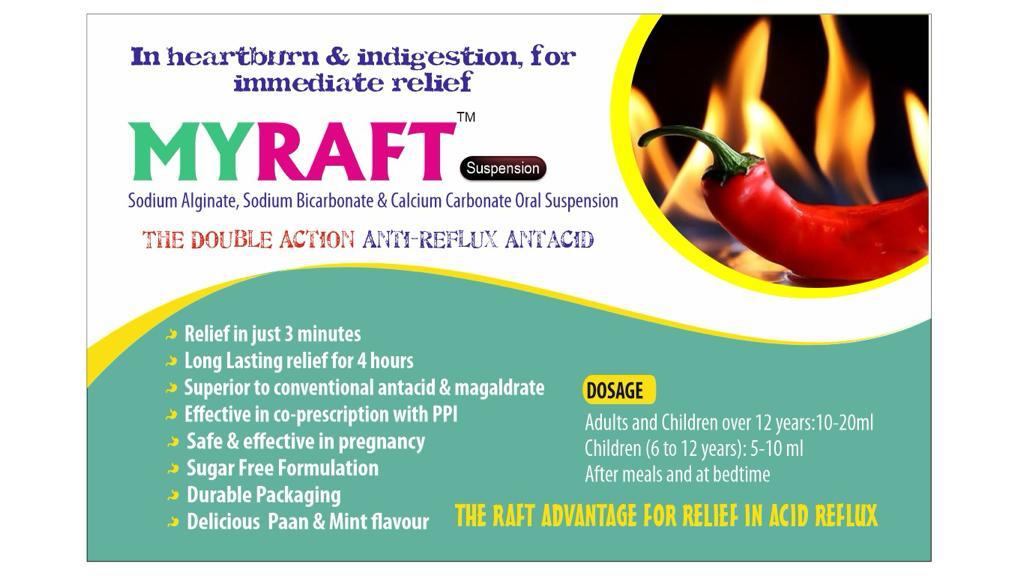
MYRAFT Oral Suspension Mint& pan Sugar Free is a combination of three medicines used in the treatment of acidity and heartburn. It neutralizes the acid present in the stomach and protects the stomach from damage due to excessive acid.
General Information
Contains
Alginic Acid (250mg/5ml)+ Calcium Carbonate (80mg/5ml)+ Sodium Bicarbonate (133.5mg/5ml)
Product introduction
MYRAFT Oral Suspension Mint & pan Sugar Free may be taken with or without food in a dose and duration advised by the doctor. Keep taking this medicine for as long as it is recommended. If you stop the treatment too early, your symptoms may come back and your condition may worsen.
This medicine may cause little to no side effects. If any of the side effects bother you or do not go away, please consult the doctor. Let them know about all the other medications you are taking as some may affect, or be affected by, this medicine.
It is important to consult a doctor before taking MYRAFT Oral Suspension Mint&pan flavour Sugar Free if you are suffering from stomach and kidney disease. Pregnant or breastfeeding women should also consult their doctor before taking this medicine.
Uses of MYRAFT Oral Suspension
* Treatment of Acidity
Acidity
Written By Dr. Sakshi Sharma
BDS
Reviewed By Dr. Varun Gupta
MD Pharmacology, MBBS
Last updated on: 17 Jan 2023 | 02:41 PM (IST)
Also known as Heartburn, Acid reflux and Hyperacidity
Overview
Acidity is one of the most common ailments that almost everyone experiences once in their lifetimes. In simple terms, it is a condition that causes excess acid production in the stomach. This not only causes discomfort in the stomach but also leads to other symptoms, such as a sour taste in the mouth, difficulty swallowing, and indigestion.
There are numerous causes of acidity, right from poor eating habits and excessive stress to the use of certain medications. Moreover, lifestyle factors, such as smoking and consuming foods loaded with oil, fats, and spices, can also up your risk of acidity.
If you experience acidity once in a while, it may not indicate any health issues. However, if you suffer from frequent bouts of acidity, where the symptoms occur at least two or more days per week, there might be some underlying disorder associated with it. It is advised to consult your doctor in such cases.
You can fight acidity with simple lifestyle changes and effective home remedies, such as tulsi, mint, fennel seeds, and cold milk. In most cases, over-the-counter medications to reduce/neutralize the acid are known to be of great help.
Key Facts
Usually seen in
* Adults above 30 years of age
Gender affected
* Both men and women
Body part(s) involved
* Esophagus
* Stomach
* Intestine
Prevalence
* Worldwide: 11.9% (2005)
* India: 7.6–18.7% (2018)
Mimicking Conditions
* GERD
* Peptic ulcer disease
* Achalasia
* Gastritis
* Dyspepsia
* Gastroparesis
Treatment
* Antacids: Aluminum Hydroxide, Magnesium Trisilicate & Calcium Carbonate
* H2 receptor blockers: Famotidine & Ranitidine
* Proton pump inhibitors: Omeprazole, Pantoprazole & Rabeprazole
* Prokinetic drugs: Domperidone, Metoclopramide & Levosulpiride
* Coating drugs: Sucralfate & Colloidal bismuth (CBS)
Specialists to consult
* General physician
* Gastroenterologist
Symptoms Of Acidity
The symptoms of acidity occur when some of the acid content of the stomach flows back up into the esophagus or the food pipe, which connects the mouth to the stomach. Normally, a ring of muscle called the lower esophageal sphincter (LES) acts as a valve that lets food enter the stomach but does not allow it back up into the esophagus. When this valve fails to function properly, stomach contents are regurgitated into the esophagus and the following symptoms of acidity can be experienced:
1. Heartburn
Despite the name, heartburn has nothing to do with the heart. It is a common symptom of acidity that is caused when the excess stomach acid leaks out into the esophagus, leading to a burning sensation in the chest. This feeling can last for a few minutes to several hours.
2. Regurgitation
Some people with acidity may experience regurgitation. It is a feeling in which the person may feel liquid undigested food, bile, or stomach acid moving up and down in the throat. This sensation is somewhat similar to the feeling of being pukish and usually occurs post meals, exercising, or bending right after eating.
3. Sour taste in the mouth
Another common symptom of stomach ailments, a sour taste in the mouth, is also a symptom of acidity. It happens when food, along with stomach acid and bile, rises up to the back of your throat, causing a bitter taste. This usually happens along with regurgitation.
4. Difficulty in swallowing
Difficulty in swallowing, also known as dysphagia, happens when excess acid in the stomach causes a feeling of fullness. It also causes a delay in the movement of food through the food pipe and impedes digestion.
5. Sore throat
When the stomach acid moves up to the mouth it can irritate the vocal cords or the voice box, leading to sore throat or hoarseness.
6. Indigestion
Indigestion, also known as dyspepsia, can also be a key sign of acidity and other digestive problems. It can lead to a feeling of discomfort and a burning sensation in the upper middle part of the stomach.
Heartburn is often confused as a symptom of heart attack. Read the article to know the difference bewteen angina, heartburn, and heart attack. Click Here
Causes Of Acidity
The stomach produces gastric acids that help in digesting food. However, due to some causes, there are times when gastric acids are produced in excess, leading to acidity. Factors affecting the function of the lower esophageal sphincter (LES) are also responsible for acid reflux.
Some of the common causes of acidity include:
1. Food and dietary factors
* Eating foods containing excessive amounts of chillies, pepper, vinegar, and paprika
* Deep fried and oily foods
* Excessive intake of caffeine in the form of tea, coffee, and chocolate
* High intake of table salt
* Diet low in fiber
* Overeating or eating at irregular intervals
* Unhealthy habits, like lying down just after eating
* Eating just before strenuous physical exercise
2. Lifestyle factors
* Frequent smoking
* Excessive intake of alcohol, soda, or carbonated drinks
* Lack of sleep
* Lack of physical activity
3. Ailments and medications
* Excessive stress, anxiety, or depression
* Stomach diseases, like peptic ulcer, gastroesophageal reflux disease, and stomach cancer
* Medications, like painkillers, antibiotics, chemotherapy medications, and antidepressants
Risk Factors Of Acidity
The following conditions are related to increased risk of acidity:
* Medical conditions, such as asthma, diabetes, celiac disease, and connective tissue disorders, like scleroderma
* Hiatal hernia
* Delayed stomach emptying
* Overweight/Obesity
* Pregnancy
* Women who are nearing menopause
* Women on hormone replacement therapy
Do not wear tight waist belts for long as they may cause heartburn.
Wearing a tight-fitting waist belt, especially for a long time can cause heartburn. This is because wearing a tight waist belt can cause a change in anterior pelvic tilt (where your pelvis is rotated forward and the spine is curved). This mostly occurs when sitting or standing and causes an increased abdominal pressure by narrowing the waist circumference and a decreased space within the abdominal cavity. Read about other lifestyle factors that can put you at risk of acidity.
Click Here
Diagnosis Of Acidity
* If you experience any symptoms of acidity, such as burning pain or discomfort (also called heartburn), regurgitation or bloating or burping (with a sour taste in the mouth), then it is wise to consult a doctor. Your doctor might do some physical examination followed by a few questions related to your daily routine to know the cause of it.
*
* If your symptoms are mild, your doctor might not recommend any tests. However, if your symptoms fail to show any improvement post-treatment or if you experience symptoms such as internal bleeding or difficulty in swallowing, then your doctor might recommend further investigation. The tests include:
* 1. Upper GI endoscopy: In this, a small flexible tube (known as endoscope) is inserted down the throat to examine the lining of the esophagus, stomach, and small intestine.
*
* 2. pH monitoring: This test helps measure stomach acid by checking how much stomach acid enters through the food pipe and how long it stays in the stomach.
*
* 3. Barium swallow test (esophagram): In this, you need to drink a liquid barium mixture and get an X-ray of the chest and upper abdomen done to help identify any physical abnormalities in the stomach or esophagus.
*
* 4. Esophageal manometry: It is a test that helps check the function of the lower esophageal sphincter (LES) and the muscles of the esophagus. It will tell your doctor if the food you eat can move through the esophagus normally or not.
*
* 5. Electrocardiogram (ECG): In some cases ECG is also recommended if you report severe chest pain or discomfort to check your heart condition. Additionally, other tests, such as biopsy, can also be recommended based on your condition and the symptoms.
* Treatment of Heartburn
*
* Heartburn
* Description of Heartburn
*
* Definition of Heartburn
*
* Heartburn or discomfort under the breastbone is a common symptom of gastroesophageal reflux disease (GERD). It is like a burning pain in the middle of the chest just under the central chest region. It is caused due to acid from the stomach moving back into the esophagus (food pipe).
*
* Causes and Risk Factors of Heartburn
*
* The burning pain is mainly caused due to direct stimulation of oversensitive food pipe lining by food and partly due to contraction of food pipe end. The burning is aggravated by bending, stooping, or lying down positions. Following are the risk factors that can cause heartburn:
* 1. Foods: Oranges, pineapple, chocolate, tomatoes, grapefruits, alcohol, carbonated beverages, caffeine, fatty, and spicy food
* 2. Drugs: Aspirin, ibuprofen, naproxen
* 3. Obesity: This increases the pressure within the abdomen thus predisposing you to reflux disease.
* 4. Smoking
* 5. Pregnancy: Pregnancy increases the pressure within the abdomen affecting the food pipe causing reflux of food into the food pipe.
* 6. Hiatus hernia: This is another condition that affects the functioning of the lower esophageal sphincter and is a risk factor for reflux.
*
* Signs and Symptoms of Heartburn
*
* Heartburn is a symptom of GERD which is felt like a burning pain behind the sternum (breastbone) and can spread to the neck, across the chest. This pain generally occurs when the patient lies flat or after bending or stooping, often immediately after a heavy meal. Consistent heartburn due to reflux may affect your voice causing hoarseness and may even cause bouts of coughing due to irritation.*
* Investigations*
* Investigations include:
* 1. X-ray: A chest x-ray helps in viewing the shape of esophagus and stomach, but it is advisable to do a barium swallow or a barium meal.
* 2. Endoscopy: The lining of esophagus and stomach can be viewed and thus any inflammation or ulcer if present can be identified. Even biopsy to rule out any particular infection or cancerous condition can be done during an endoscopy.
* 3. Manometry and pH monitoring: Monitoring the pressure at the end of the food pipe and obtaining acid measurements from within it may be helpful in making the diagnosis.
*
* Treatments of Heartburn
*
* There are many over-the-counter medicines that are available that could relieve your heartburn.
* 1. Antacids: These drugs help in neutralizing the acid in the stomach thus reducing the symptoms of heartburn, e.g., magnesium carbonate antacids.
* 2. Proton pump inhibitor: These drugs block the production of acid in the stomach, e. g., pantoprazole, omeprazole, and rabeprazole.
* 3. H2-receptor antagonist: These drugs reduce the acid production from the stomach, e.g., ranitidine, cimetidine, and famotidine.
*
* Complications and When Should You See a Doctor
*
* If left untreated, the irritation caused due to acid reflux can lead to inflammation of the esophageal lining (esophagitis). Later, this inflammation becomes severe, narrowing your esophagus, and may lead to bleeding or difficulty in swallowing (dysphagia).
* Skipping meals, eating spicy and fatty foods, eating outside food regularly can cause heartburn. If you suffer from heartburn even after changing this routine, see your physician. You should visit a medical professional if there is no relief after using over-the-counter medicines, or the symptoms worsen or the frequency of complaints increases.
*
Benefits of MYRAFT Oral Suspension
Treatment of Acidity
MYRAFT Oral Suspension Mint & pan Sugar Free relieves excessive acidity in your stomach which prevents heartburn and indigestion. Usually, it is used along with other medicines for the management of this condition. Continue taking it for as long as the doctor advises you to get the most out of it. Take a fiber-rich diet, avoid oily or spicy food, and drink plenty of fluids while taking it to keep yourself hydrated.
Treatment of Heartburn
Heartburn is a burning feeling in your chest caused by stomach acids traveling back up in your throat and mouth (acid reflux). MYRAFT Oral Suspension Mint Paan Sugar Free improves the movement of food in the stomach and helps prevent heartburn. Take it exactly as it is prescribed or as it says on the label for it to be effective. Some simple lifestyle changes can help stop or reduce heartburn. Observe which foods trigger heartburn and try to avoid them, eat smaller, more frequent meals, try to lose weight if you are overweight, and try to find ways to relax. Do not eat within 3 to 4 hours of going to bed.
Side effects of MYRAFT Oral Suspension
Most side effects do not require any medical attention and disappear as your body adjusts to the medicine. Consult your doctor if they persist or if you’re worried about them
Common side effects of MYRAFT
* Limited data available
How to use MYRAFT Oral Suspension
Take this medicine in the dose and duration as advised by your doctor. Check the label for directions before use. Measure it with a measuring cup and take it by mouth. Shake well before use. MYRAFT Oral Suspension Mint Paan Sugar Free may be taken with or without food, but it is better to take it at a fixed time.
How MYRAFT Oral Suspension works
MYRAFT Oral Suspension Mint PaanSugar Free is a combination of alginic acid, calcium carbonate, and sodium bicarbonate. Alginic acid forms a protective foam layer that floats on top of the contents of the stomach. This prevents stomach acid from escaping into the food pipe. Calcium carbonate and sodium bicarbonate are antacids that neutralize gastric acid.