
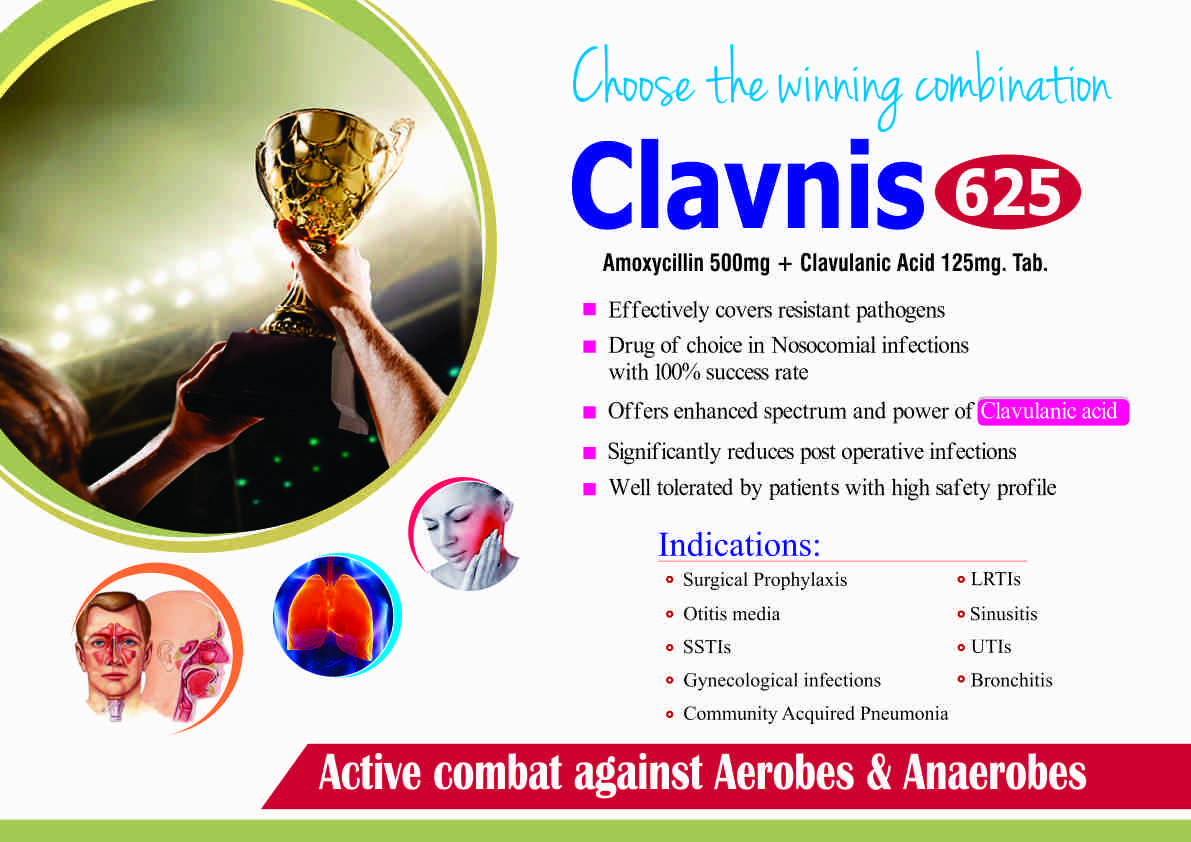
COMPOSITION: CLAVNIS 625 Each film-coated tablet contains: Amoxycillin Trihydrate I.P. equivalent to Amoxycillin 500 mg Potassium Clavulanate Diluted I.P. equivalent to Clavulanic Acid 125 mg
Colour : Titanium Dioxide I.P.
PHARMACOLOGICAL CLASSIFICATION: Penicillins.
DESCRIPTION: Amoxycillin Trihydrate
Amoxycillin Trihydrate is (6R)-6-(α-4-hydroxyphenyl-D- glycylamino) penicillanic acid trihydrate. It has empirical formula of C16H19N3O5S, 3H2O and molecular weight of 419.5. Amoxycillin Trihydrate is slightly soluble in water,in ethanol (95%) and in methanol, practically insoluble in chloroform, in ether and in fixed oils. It is soluble in dilute solutions of acids and alkali hydroxides. Amoxicillin is a broad spectrum bactericidal antibiotic, which is active against both Gram-positive and Gram-negative organisms.
Potassium Clavulanate
Potassium Clavulanate Diluted is a dry mixture of Potassium Clavulanate[(Z)-(2R,5R)-3-(2-hydroxyethylidene)-7-oxo- 4-oxa-1-azabicyclo{3.2.0}heptane-2-carboxylate]and Microcrystalline Cellulose, or Silica,colloidal anhydrous or Slica, colloidal hydrated. It has empirical formula of C8H8KNO5 and molecular weight of 237.3.
PHARMACOLOGICAL ACTION: CLAVNIS Clav is a combination of amoxycillin and clavulanic acid. Clavulanic acid itself has only a minimal antibacterial action. However, by binding irreversibly to the beta-lactamases produced by many strains of organisms usually resistant to penicillins, the clavulanic acid protects the amoxicillin from hydrolysis. Clavulanic acid has been shown in vitro, to be an irreversible inhibitor of beta-lactamases produced by many bacteria including: Escherichia coli; Haemophilus influenzae; Klebsiella pneumoniae; Bacteroides fragilis; Staphylococcus aureus as well as Proteus vulgaris; Proteus mirabilis and Neisseria gonorrhoeae.
Type 1 beta-lactamases of the Richmond-Sykes classification are not inactivated by clavulanic acid, and this includes those produced by Enterobacter; Citrobacter and Serratia marcescens as well as the Acinetobacter and Providencia species and indole positive Proteus. The combination of amoxicillin and clavulanic acid has shown in vitro, to have a synergistic action against amoxicillin resistant organisms. There is no evidence of antagonism. ( In vitro activity does not necessarily imply in vivo efficacy). Pharmacokinetics: The pharmacokinetics of amoxicillin are very similar to that of clavulanic acid. Food has no affect on the absorption of either amoxicillin or clavulanic acid. Peak serum levels are reached between one to two hours. There is very little effect on the excretion rate of clavulanic acid when probenecid is concomitantly administered.
INDICATIONS: CLAVNIS is indicated for the treatment of infections caused by all organisms sensitive to amoxicillin, as well as those organisms which produce beta-lactamases that are sensitive to clavulanic acid. This includes: - Infections of the upper respiratory tract (otitis media) - Infections of the lower respiratory tract (bronchitis) - Infections of the genito-urinary tract - Infections of the skin and soft tissues
CONTRA-INDICATIONS : CLAVNIS is contra-indicated in patients with: - a history of allergic reactions to either penicillins and/or cephalosporins. - a previous history of jaundice and/or hepatic dysfunction associated with amoxicillin and clavulanic acid. Safety in pregnancy has not been established.
WARNINGS : When administered to a patient with a penicillin allergy, serious and occasionally fatal hypersensitivity (anaphylactoid) reactions may occur and although this occurs more frequently after intravenous administration, oral therapy has been known to illicit the same response. When considering starting therapy with CLAVNIS, previous history of hypersensitivity to penicillins cephalosporins or other allergens must therefore be excluded. If an allergic reaction occurs, CLAVNIS should be discontinued. Adrenaline, corticosteroids and antihistamines should be used to treat anaphylaxis. Reversible hepatitis and cholestatic jaundice has been reported with amoxicillin and clavulanic combination so that CLAVNIS should be used with caution in patients with evidence of hepatic dysfunction.
DOSAGE AND DIRECTIONS FOR USE: The presence of food does not affect the absorption of CLAVNIS Clav, so that CLAVNIS Clav may be taken on a full or empty stomach. In that the incidence of any possible gastrointestinal side-effects is reduced in the presence of food, it is recommended that CLAVNIS Clav be taken at the beginning of a meal. Both the CLAVNIS (250 mg amoxicillin) and 625 (500 mg amoxicillin) tablets contain 125 mg clavulanic acid, so that two CLAVNIS tablets are not equivalent to one CLAVNIS Clav 625 tablet and so should therefore not be used interchangeably. Excretion takes place through the kidneys so that patients with renal function impairment should have their dose reduced to the dosing interval extended. The following guideline may be used for dose adjustments : Creatinine clearance in mL/min Dosing interval in hours >30 8 (no change) 10-30 12 2-10 24 Haemodialysis removes both amoxycillin and clavulanic acid from the blood so that an additional dose should be given after dialysis.
Dosage guide for Organisms sensitive Organisms resistant Adults and amoxicillin to amoxicillin Adolescents to H. influenza > 40 kg H. parainfluenza Infections of the 375 mg tablet 2 tablets every Upper respiratory 1-2 tablets every 8 hours tract 8 hours e.g. Otitis media 625 mg tablet 1 tablet every 1 tablet every 8 hours 8 hours H. Influenza H. parainfluenza Infections of the 375 mg tablet 2 tablets every lower respiratory 1-2 tablets every 8 hours tract 8 hours e.g. Bronchitis 625 mg tablet 1 tablet every 1 tablet every 8 hours 8 hours E: coli K. pneumoniae Infections of the 375 mg tablet 1-2 tablets every Urinary tract 1-2 tablets every 8 hours 8 hours 625 mg tablet 1 tablet every 1 tablet every 8 hours 8 hours S. aureus Infections of the 375 mg tablet 1-2 tablets every Skin & Soft tissue 1-2 tablets every 8 hours 8 hours 625 mg tablet 1 tablets every 1 tablet every 8 hours 8 hours
SIDE-EFFECTS AND SPECIAL PRECAUTIONS: Side-effects: The most common adverse effects are hypersensitivity reactions; especially skin rashes; anaphylaxis occasionally occurs and has sometimes been fatal. Hepatitis and cholestatic jaundice have been reported with the combination amoxycillin with clavulanic acid; the clavulanic acid component has been implicated. Erythema multiforme (including the Stevens-Johnson syndrome), toxic epidermal necrolysis, and exfoliative dermatitis have also been attributed occasionally to amoxycillin with clavulanic acid. Skin rashes are however the most common side-effects and are generally either urticarial or maculopapular; the urticarial reactions are typical of penicillin hypersensitivity. The incidence of maculopapular rash is especially high in patients suffering from infectious mononucleosis. Haemolytic anaemia and neutropenia have been reported. Treatment with CLAVNIS Clav can cause gastro-intestinal adverse effects particularly diarrhoea nausea, vomiting occur quite frequently, a sore mouth or tongue or a black hairy tongue have been reported, usually following administration by mouth and are dose related and can be minimised by administering the medicine at the start of a meal. In addition, as these symptoms are especially related to the potassium clavulanate component, where these gastro-intestinal symptoms occur and a higher concentration of amoxicillin is required, consideration should be given to administering the additional amoxicillin separately. Pseudomembranous colitis has also been reported. Treatment with CLAVNIS Clav may lead to the selection of resistant strains of organisms and sensitivity testing should, therefore, be carried out whenever possible, to demonstrate the appropriateness of therapy. Monilial overgrowth such as vaginitis and thrush have been reported.
Special Precautions: Therapy should be discontinued if a skin rash occurs. Should a serious anaphylactic reaction occur, CLAVNIS Clav should be discontinued and the patient treated with the usual agents:
adrenalin, corticosteroids and antihistamines. Patients known to be hypersensitive to penicillin should be given an antibiotic of another class. However, sensitised patients may also react to the cephalosporins and other beta-lactam antibiotics. Desensitisation may be necessary if treatment with penicillin is essential. CLAVNIS Clav should be given with caution to patients with a history of medicine allergy. Care is necessary if very high doses of penicillin are given, especially if renal function is poor, because of the risk of neurotoxicity. Care is also necessary if large doses of potassium or sodium salts are given to patients with impaired renal function or heart failure. Renal and haematological status should be monitored during prolonged and high-dose therapy. Patients with syphilis may experience a Jarisch-Herxheimer reaction, symptoms like fever, chills, headache and reactions at the site of lesions may be experienced. The reaction can be dangerous in cardiovascular syphilis or where there is a serious risk of increased local damage such as with optic atrophy. Contact with penicillin should be avoided since skin sensitisation may occur. CLAVNIS Clav therapy changes the normal bacterial flora and can lead to supra-infection with penicillin-resistant organisms including Pseudomonas or Candida, particularly with prolonged use. Interactions: Probenecid prolongs the half-life of benzylpenicillin. An increased frequency of skin rashes has been reported in patients receiving amoxicillin together with allopurinol.
SYMPTOMS OF OVERDOSAGE AND PARTICULARS OF ITS TREATMENT: Nausea, vomiting and diarrhoea may occur with overdosing. Treatment is symptomatic and supportive.
IDENTIFICATION : White to almost white oval, biconvex, film coated tablets.
EXPIRY DATE : Do not use later than date of expiry.